As of March 12, 2026
GOVERNMENT OUTREACH:
ASHRAE Hosts Congressional Briefing on Indoor Air Quality
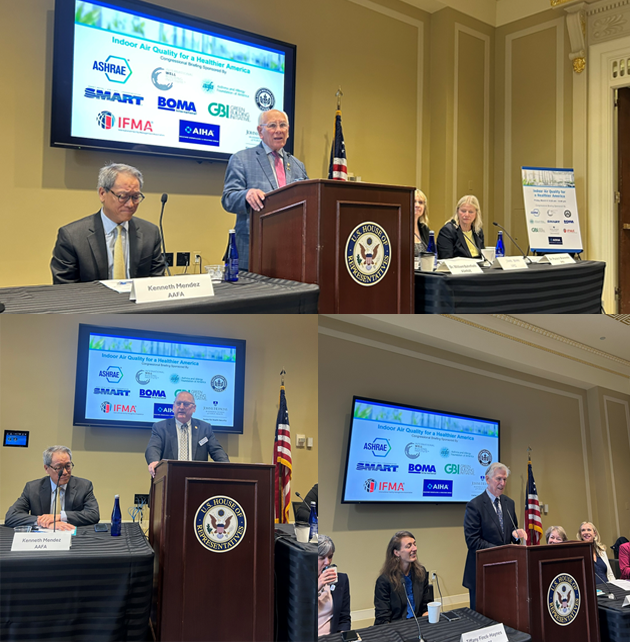
Reps. Tonko (top) and Beyer (bottom-right) and ASHRAE Presidential Member
Bill Bahnfleth (bottom-left) speak.
On March 6, ASHRAE partnered with 9 other leading organizations in the building sciences and human health communities to convene a congressional briefing highlighting the vital role indoor air quality plays in bettering public health and increasing economic productivity. The program “Indoor Air Quality for a Healthier America” featured remarks from Reps. Paul Tonko (D-NY) and Don Beyer (D-VA) as well as expert panel discussions on IAQ fundamentals and policy opportunities. Among the panel speakers was ASHRAE Presidential Member Bill Bahnfleth, who spoke about the critical role of ASHRAE standards in undergirding efforts to improve IAQ.
Postings from Local / State / Federal Organizations are approved by the Chapter President. For further government activity posts / outreach activities, please feel free to contact David Cotton c192gac@ashrae.net (GAC Chair) or Rex Camit c192gacc@ashrae.net (GAC Co-Chair).
ASHRAE’s Tennessee Chapters Convene in Nashville for Government Outreach Day
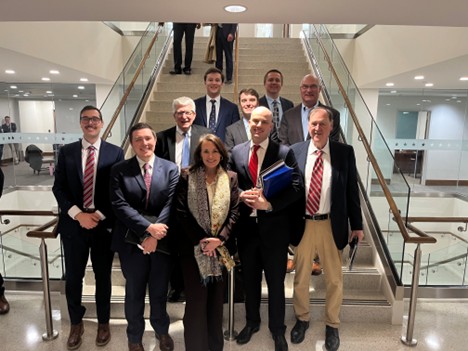
ASHRAE’s TN Chapters in the State Capitol Office Building
On February 25, a team of 9 volunteers representing ASHRAE’s Knoxville (East Tennessee), Nashville, and Memphis Chapters (Region VII) traveled to Nashville, Tennessee to meet with lawmakers at the state capitol. The volunteers: Jim Murphy, Matthew Martinez, Dave Burggren, Justin Ford, Marty Harrington, Stephanie Cianciola, Jennings Thigpen, Foster Ligon, and Mike Bilderbeck, were scheduled to meet with 23 elected officials throughout the day. However, last-minute changes to the legislative calendar stemming from a budget dispute in the senate caused the entire agenda to shift the night before. More than a dozen meetings still took place, with the team introducing lawmakers to ASHRAE, sharing the society’s public policy priorities, and beginning the work of finding legislative champions.
ASHRAE Joins Engineering Groups in Letter to
Department of Education
In a letter led by the National Society of Professional Engineers, ASHRAE joined five other organizations representing different parts of the engineering community to comment on a proposed U.S. Department of Education rule that would change how graduate degrees are classified and borrowing limits based on those classifications. The proposed rule, published in the Federal Register on January 30, defines “professional degrees” as distinct from other graduate degrees and allows students pursuing those degrees access to greater annual and lifetime access to federal student borrowing. The letter highlights the importance of engineering and urges the Department of Education to recognize graduate engineering programs as “professional.” The letter is available here.
ASHRAE Opposes Connecticut Bill That Would Prevent Future Building Code Updates
On March 5, ASHRAE President Bill McQuade sent a letter to the Connecticut General Assembly’s Joint Committee on Public Safety and Security opposing HB 5401, which would prohibit the state building code from being revised more frequently than once every six years and prohibit any new building code updates from 2026 to 2032, effectively freezing the code for the next 6 years. The letter was submitted as written testimony for the Joint Committee’s hearing on the legislation on March 5, and ASHRAE staff testified virtually in opposition to the legislation at that committee hearing. The committee has not yet voted on the legislation.
FEDERAL GOVERNMENT AFFAIRS:
ENERGY STAR Program Oversight to Move from EPA to DOE
On March 3, the U.S. Environmental Protection Agency (EPA) and Department of Energy (DOE) released a memorandum of agreement (MOA) to move primary oversight and management of the ENERGY STAR program from EPA to DOE. The MOA states that all ENERGY STAR activities, including partnership agreements, trademarks, as well as IT systems, will transition to DOE. EPA and the Small Business Administration will consult as needed. This transition comes shortly after Congress funded the program at EPA at $33M for Fiscal Year 2026. The agencies are expected to release a transition plan within 90 days of MOA publication, outlining specific timelines for the transition. More information can be found here.
Federal Court Rules Against HUD-USDA Housing
Energy Efficiency Standards
On March 6, a federal judge for the U.S. District Court for the Eastern District of Texas ruled the U.S. Department of Housing and Urban Development (HUD) and Department of Agriculture’s (USDA) 2024 final determination adopting the 2021 International Energy Conservation Code (IECC) and ASHRARE Standard 90.1-2019 for federally funded housing was unlawful under the Administrative Procedures Act. The ruling sides with 15 Republican-led states and the National Association of Home Builders (NAHB), who sued the Biden administration in January 2025, arguing the new minimum energy standards would reduce the affordability and availability of low-income housing. The Trump administration is presently reconsidering the final determination and has extended compliance three times since the start of his administration. The ruling can be found here.
GSA Relaunches High Performance Building
Advisory Committee
On March 4, the General Services Administration’s (GSA) Office of Government Wide Policy released a notice inviting qualified applicants for an appointment to serve on GSA’s High-Performance Building Advisory Committee (HBAC). Formerly known as the Green Building Advisory Committee, HBAC will advise GSA on the Trump administration’s priorities for the federal building portfolio including those related to executive orders on “Making Federal Architecture Beautiful Again,” improving federal design, and promoting American energy sources. The notice can be found here.
STATE AND LOCAL GOVERNMENT AFFAIRS:
Chicago Relaunches Energy Benchmarking Program
In early March, Chicago Mayor Brandon Johnson and the Chicago Department of the Environment announced that the city’s energy benchmarking program would be relaunched. Originally established in 2013, the program requires building owners and managers of buildings 50,000 square feet and greater report annual building energy use to the city, which is publicly available on the city’s data portal. The relaunch includes a new support team of city employees and private energy companies along with a new reporting platform for building owners. Since 2016, carbon emissions from Chicago buildings subject to the benchmarking requirements have decreased by 39%, but buildings are still the largest source of emissions in the city.
Connecticut Governor Announces New Fund for Energy Efficiency Upgrades
Connecticut Gov. Ned Lamont recently announced that the state plans to allocate $18 million to establish a Housing Environmental Improvement Revolving Loan and Grant Fund through the state Department of Energy and Environmental Protection. The funding will be available to homeowners and residents of single-family homes and multifamily housing statewide to make energy efficiency, weatherization and electrification upgrades. $6 million is specifically dedicated to remediation of low-income single-family homes with existing health and safety issues like asbestos, mold, and moisture damage that would otherwise prevent homeowners from moving forward with energy audits, adding insulation, or other efficiency upgrades. The remaining $12 million will support energy upgrades and retrofits in existing affordable multifamily housing.
For additional information on government affairs issues, please contact GovAffairs@ashrae.org.
As of February 12, 2026
GOVERNMENT OUTREACH:
ASHRAE To Host Congressional Briefing:
Indoor Air Quality for a Healthier America
On March 6, ASHRAE will partner with nine leading organizations in the building sciences and human health communities to convene this briefing highlighting the important role of indoor air quality (IAQ) to bettering public health and increasing economic productivity. The program will include remarks from Representatives Paul Tonko (D-NY), Don Beyer (D-VA), and Brian Fitzpatrick (R-PA) (invited), as well as expert panel discussions on IAQ fundamentals and policy opportunities to support continued innovation in this space. The briefing will take place in the Rayburn House Office Building Gold Room from 9:30 a.m. to 12:00 p.m. on Friday, March 6. Breakfast and light refreshments will be provided. Attendees are encouraged to RSVP here.
ASHRAE Sends Letter Opposing Bill Prohibiting Energy
Data Sharing Requirements for Utilities
On January 28, ASHRAE President Bill McQuade sent a letter to the Indiana House Homeland Security and Transportation Committee regarding HB 1150 “Building Energy Data Access Legislation,” opposing a provision in the bill that would prohibit a county or municipality from adopting or enforcing a utility usage data ordinance. This prohibition would essentially prevent the implementation of building benchmarking or building performance standard reporting requirements, by allowing utilities to withhold building energy usage data from building owners and managers. The bill has since passed the House and is now in the Senate.
GLOBAL GOVERNMENT AFFAIRS:
New European Union Study Recommends Exempting Refrigerants from PFAS Restrictions
In December 2025, the European Parliament’s Policy Department for Transformation, Innovation and Health issued a study recommending that “F-gases”, including refrigerants, should be excluded from future EU restrictions on per- and poly-fluoroalkyl substances (PFAS), also known as “forever chemicals”. The currently proposed PFAS restrictions in the EU would result in a ban on virtually all new lower-GWP refrigerant blends, except R32. The study concludes that “substitution of these F-gases is not currently feasible given economic, technical and safety constraints”. It recommends that any regulations related to refrigerant gases be instituted by revising the existing F-gas regulations, which would allow for a more nuanced and substance-specific approach than a blanket PFAS ban.
U.S. CONGRESSIONAL ACTIVITIES:
Members of Congress Introduce Multiple Bills Addressing Data Centers
Several bills have been introduced by members of Congress to address the environmental and affordability challenges arising from the growing electricity demand from AI and data centers.
- On January 15, Senator Chris Van Hollen (D-MD) introduced S. 3682, the “Power for the People Act.” The bill would require data centers to supply their own power and make data center companies responsible for the costs to increase grid capacity to accommodate usage. The legislation also provides resources for more accurate data center load forecasting. More information on the legislation can be found here.
- On January 14, Reps. Mike Levin (D-CA) and Kathy Castor (D-FL) introduced H.R. 7066, the “Stopping Hikes In Electricity from Large Load Demands (SHIELD) Act.” The legislation would amend the Public Utility Regulatory Policies Act to direct state public utilities commissions (PUCs) to consider implementing two new federal standards. One standard would ensure households don’t pay for grid upgrades from large-load facilities, and the other would incentivize large-load facilities to use zero-emission electricity and energy saving measures such as energy efficiency and on-site energy storage. More information on the legislation can be found here.
- On January 8, Reps. Rob Menedez (D-NJ-) and Greg Casar (D-TX) introduced H.R. 6983, the “Preventing Rate Inflation in Consumer Energy (PRICE) Act” and H.R. 6984, “the Data Center Transparency Act.” The PRICE Act would require data centers to generate the electricity they consume and that it be 100% renewable by 2040. The Data Center Transparency Act would require the Environmental Protection Agency to collect and update data every three months on the environmental impacts that data centers.
- On January 8, Senator Tom Cotton (R-Ark.) introduced S.3585, the “Decentralized Access to Technology Alternatives (DATA) Act.” This legislation would create a new class of power producers known as “consumer-regulated electric utilities (CREU),” that could provide retail service to new electric loads if their system is physically isolated from the bulk power grid and other utilities. The CREUs would be exempt from most federal regulations governing electricity production and transmission. This would allow data center developers to build on-site generation and distribution systems separate from the grid at faster timelines. More information on the legislation can be found here.
FEDERAL GOVERNMENT AFFAIRS:
DOJ Files Lawsuit Against Two California Cities’ Gas Bans
On January 7, the U.S. Department of Justice (DOJ) filed a lawsuit against the Bay Area cities of Morgan Hill and Petaluma, California regarding their ordinances banning natural gas in new construction. The complaint, filed in the U.S. District Court for the Northern District of California, argues that the cities’ gas bans are preempted by the Energy Policy and Conservation Act (EPCA) of 1975 because it prevents jurisdictions from using differing standards for the energy use and efficiency of covered appliances, so it automatically invalidates local bans preventing the use of gas appliances. This is the same argument that successfully overturned Berkeley, California’s gas ban in the 9th U.S. Circuit Court in 2023. However, it has since proved unsuccessful in overturning New York City and New York State’s fossil fuel emissions restrictions. To date, approximately 150 local governments across the U.S. have adopted some form of restrictions on greenhouse gas emissions in new buildings.
Department of Education Publishes Proposed Rule
Limiting Graduate Student Loans
On January 30, the U.S. Department of Education published a notice of proposed rulemaking (NPRM) that would codify a new definition for “professional degrees” and allow students pursuing those degrees to access greater annual and lifetime levels of graduate student loans. The NPRM builds on new limits to student borrowing included in the Trump administration’s “One Big Beautiful Bill Act” which became law last summer. The 13 “professional degrees” primarily relate to healthcare. The department is accepting public comments until March 2.
STATE AND LOCAL GOVERNMENT AFFAIRS:
School Indoor Air Quality Legislation Introduced in Illinois
On February 2, identical legislation was introduced in both chambers of the Illinois General Assembly (HB 4739, SB 3110) that would require the state Board of Education and Department of Public Health to develop an educational document explaining the values of good indoor air quality (IAQ) to provide to school districts and require school districts to ensure that all active classrooms are equipped with an air quality monitor. The legislation is currently in the Senate Assignments Committee and the House Rules Committee and has not yet had a hearing.
Decline in New York City GHG Emissions Attributed to Buildings Policies
In December 2025, New York City’s annual greenhouse gas (GHG) inventory report showed that in 2024, the city’s emissions declined to levels not seen since the height of the COVID pandemic in 2020. Total GHG emissions in 2024 were 5% below the previous year, and 25% below 2005 levels, when the city first began tracking such emissions. One of the biggest contributors to this decline was emissions from buildings, which were 5% below the previous year and 27% below 2005 levels. Also, transportation emissions were down more than 22% and waste emissions by 19% since 2005. Local Law 97, the city’s flagship GHG emissions reduction requirements for buildings over 25,000 square feet, went into effect in 2024.
OTHER NEWS AND EVENTS:
ACEEE Study:
Energy Efficiency Can Address Surging Electricity Needs at Half the Cost of Gas Plants
The American Council for an Energy Efficient Economy (ACEEE) recently published a report showing how improving energy efficiency (EE), is the lowest-cost option for reducing electricity consumption and peak demand. Examining multiple methods for meeting increased electricity demand, the report shows that demand-side EE programs with measures such as heat pump utilization, in addition to improving efficiency of other appliances and insulation had the lowest median cost of all, at $20.70/MWh. This cost is significantly less than that of all the supply-side options examined, whose median costs ranged from $27/MWh to almost $200/MWh.
As of January 15, 2026
GOVERNMENT OUTREACH:
Mayor of Charlotte, North Carolina Signs National
Engineers Week Proclamation
On January 7, Mayor Vi Alexander Lyles of Charlotte, North Carolina, signed a proclamation declaring the week of February 22–28, 2026 as Engineers Week. Billy Austin, a member of ASHRAE’s Southern Piedmont Chapter in North Carolina, coordinated the proclamation signing with the mayor’s office. National Engineers Week, established in 1951, is an annual celebration of the engineering workforce focused on increasing interest in engineering careers. More information on National Engineers Week can be found here.
If you are an ASHRAE member interested in learning how your chapter can request a proclamation from government officials, visit the Advocacy Toolkit page on the ASHRAE website or contact ASHRAE government affairs staff at GovAffairs@ashrae.org.
GLOBAL GOVERNMENT AFFAIRS:
United States Withdraws from 66 International
Organizations Including UNFCCC
In February 2025 the Trump administration instructed the U.S. Department of State to review U.S. support for all global agreements and organizations. Subsequently, in an executive order issued on January 7, 2026, the country withdrew from 66 such organizations, including the U.N. Framework Convention on Climate Change (UNFCCC). The UNFCCC was established in 1992 as a treaty that sets a legal framework for international negotiations to address climate change. Under the treaty, nations gather annually for the Conference of Parties (COP) summit, and nations have used this framework to set their climate targets with mechanisms like the Paris Agreement and the Kyoto Protocol. Withdrawal from the treaty makes American participation in future climate action uncertain.
U.S. CONGRESSIONAL ACTIVITIES:
House Passes Government Funding Legislation
On January 8, the U.S. House of Representatives passed a package of government spending bills for fiscal year (FY) 2026, which began on October 1, 2025. The legislation would fund several agencies through September 30, 2026, including the Department of Energy (DOE), Environment Protection Agency (EPA), and National Institute of Standards and Technology (NIST). Highlights include:
- $15 million for the Building Energy Codes Program at DOE, which is in line with FY25 funding levels.
- $33 million for ENERGY STAR at EPA, which is a $1million increase from FY25 funding levels.
- $1.84 billion for NIST, which is a $70 million increase from FY25 funding levels.
More information on the legislation can be found here. The Senate is expected to pass this legislation; however, to avoid a partial shutdown, Congress must still pass six other appropriations bills to fund the rest of the government before federal funding expires on January 30.
STATE AND LOCAL GOVERNMENT AFFAIRS:
New York State Law Ends Free Natural Gas
Hookups for Residential Buildings
On December 19, New York Gov. Kathy Hochul signed into law Senate Bill 8417, ending the “100-foot rule” for natural gas hookups for new residential buildings. This rule, in place since the 1980s, prevented utility companies from charging for new natural gas hookups for new homes if the building or development was within 100 feet of an existing gas line. The rule was originally intended to incentivize the use of natural gas for home heating instead of coal, and the new law similarly incentivizes the transition in new construction to electricity. Natural gas hookups will still be allowed for new construction, but they must be paid for by the individual customer. Analysis by RMI, a nonpartisan nonprofit focused on energy and climate issues, estimates the new law could save utility ratepayers statewide approximately $200 million per year on their electricity bills.